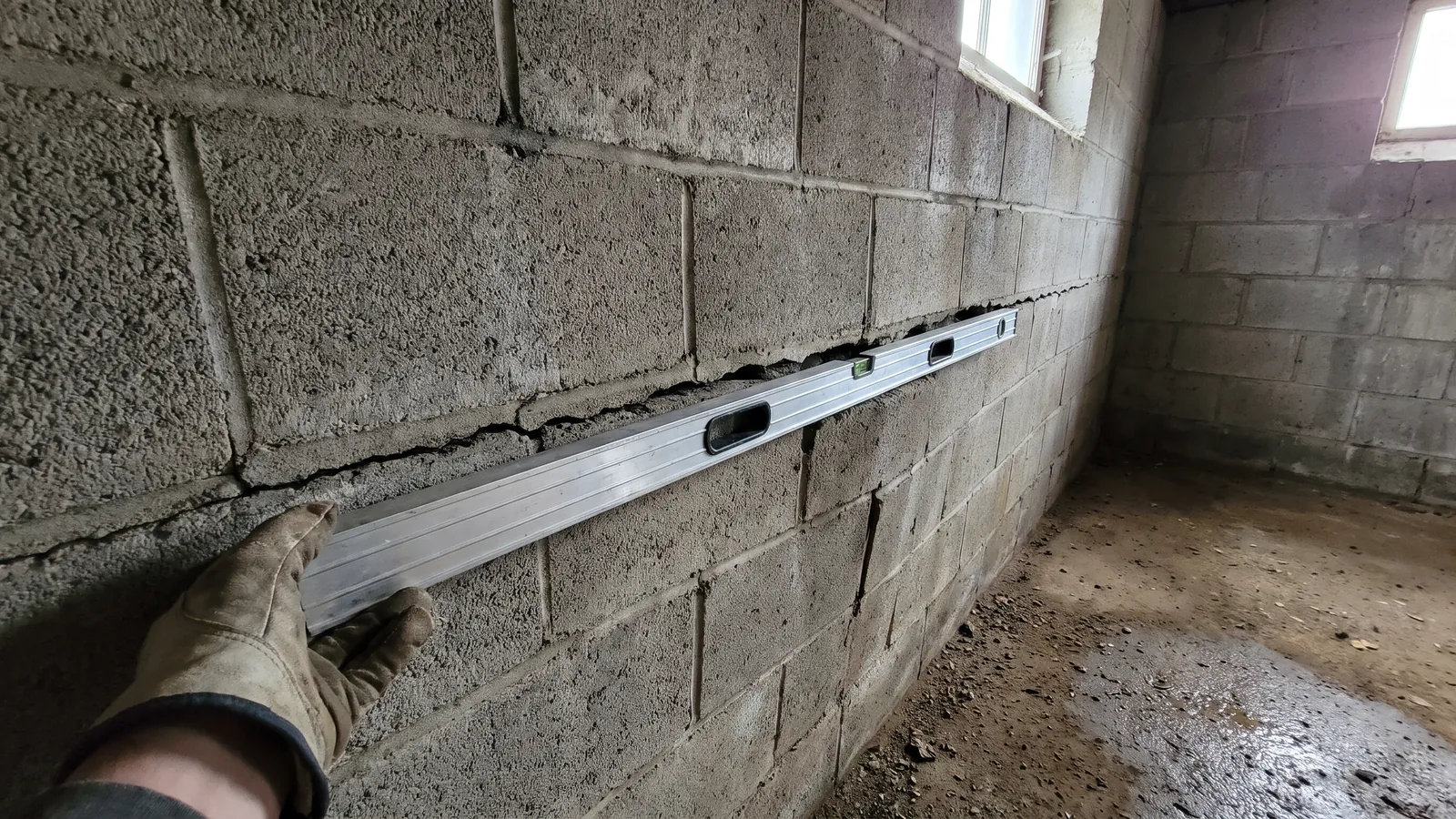
Every concrete or masonry wall cracks somewhere. What matters is the kind of crack, and whether it is still moving. Here are the common types, roughly from least to most concerning.
| Crack | Where | Usual cause | Concern |
|---|---|---|---|
| Hairline vertical | Poured walls | Shrinkage as concrete cured | Low, unless it leaks |
| Vertical, wider than 1/8 in. | Poured walls | Shrinkage plus some settling | Low to moderate; seal and watch |
| Diagonal from a corner | Poured walls | One part of the footing settling | Moderate; check floor levels |
| Stair-step | Block and brick | Settling at a corner or soil pressure near a corner | Moderate to high if widening |
| Horizontal | Block walls, mid-height | Soil pressure pushing the wall in | High; needs support |
| Crack with offset | Any | Wall sliding or rotating | High |
Four questions to ask about any crack
- Which way does it run? Vertical is usually shrinkage. Horizontal is usually pressure. Diagonal and stair-step usually mean settling.
- Is it wider at one end? A crack that tapers shows which way something moved.
- Do the two sides line up? If one side sticks out past the other, the wall has shifted.
- Is it changing? Mark it, measure it, check again after rain and after a dry spell.
Why Louisville walls crack the way they do
Block basement walls are common in houses built from the 1950s through the 1970s, and those are the walls that show horizontal cracks when wet clay pushes on them. Poured walls are more common in newer homes and tend to show vertical shrinkage cracks, which mostly need sealing only if water comes through. Brick veneer on the outside often shows stair-step cracks where a corner has settled.
When in doubt, a crack gauge, which is a small plastic plate fixed across the crack, shows movement to a fraction of a millimeter over weeks. We install them during inspections when the answer isn't obvious.
Quick answers
What width is too wide?
There's no single number, but horizontal cracks of any width in block walls, and any crack that is growing, should be looked at.
Do cracks in the garage floor matter?
Usually less. Garage slabs float on the soil and crack as they shrink. A slab that has dropped or tilted is a different matter.